

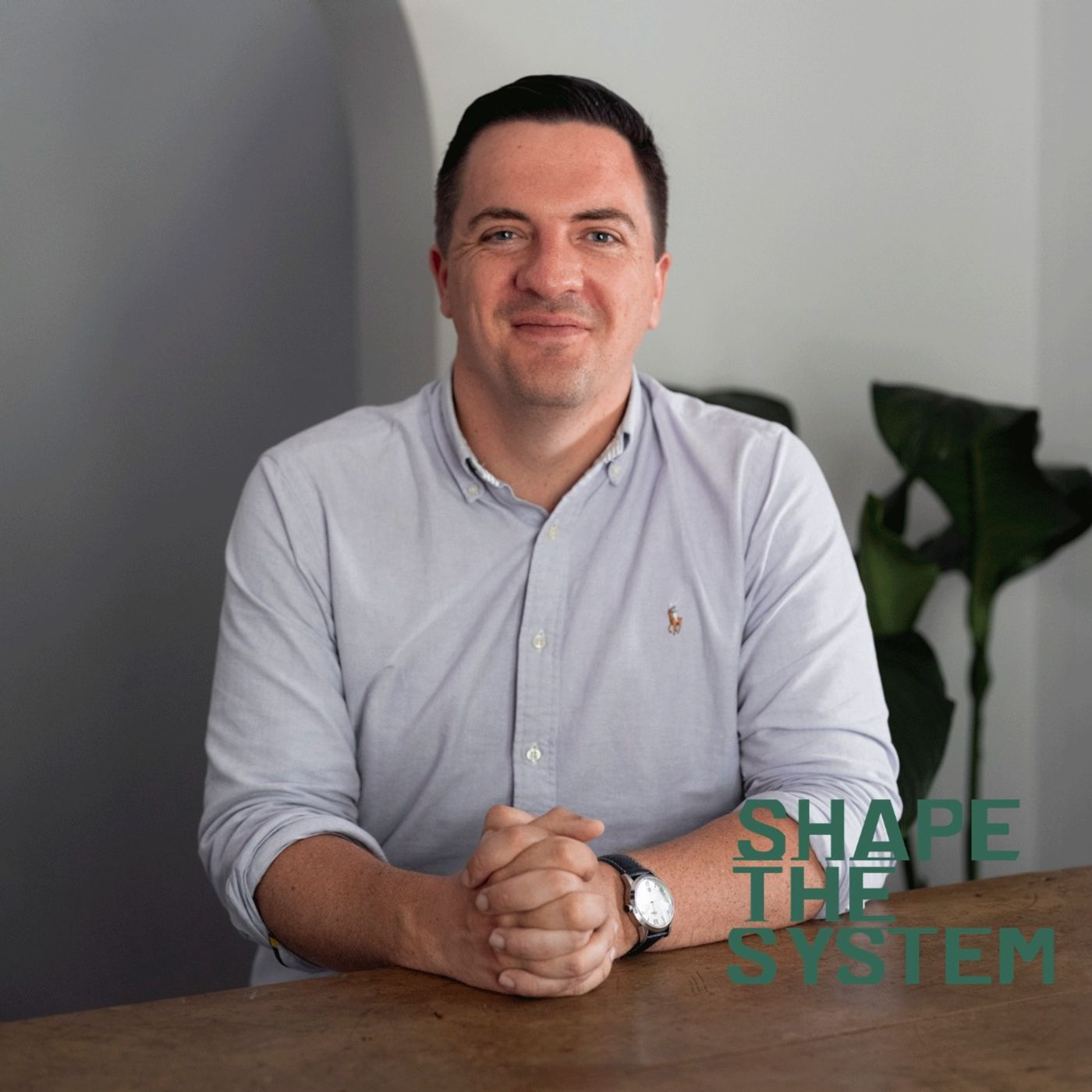
About the Guest
Lewis Dunnigan is the CEO and co-founder of Bygen, an Australian deep-tech company reimagining how activated carbon is produced. Lewis came to the problem through his PhD research at the University of Adelaide, where he and his team recognised the commercial potential of their work and spun out the company. He brings both the scientific depth of an academic researcher and the commercial pragmatism of a founder who has already shipped product to customers on multiple continents.
Episode Summary
Activated carbon is one of the most widely used industrial materials on the planet — and one of the least talked about. It filters your drinking water, treats industrial gas emissions, recovers gold from ore, remediates contaminated land, and even plays a role in pharmaceutical processing and energy storage. In this episode of Shape the System, host Vincent Turner sits down with Lewis Dunnigan, CEO of Bygen, to unpack what activated carbon actually is, why the way it's currently made is both costly and environmentally damaging, and how Bygen's production technology is changing the equation.
At its core, activated carbon is a highly porous solid material — visually indistinguishable from barbecue charcoal — but with a surface area so vast that a single teaspoon contains the equivalent of a football field. That porosity is what makes it such a powerful filtration medium: contaminants in liquids and gases are physically attracted to and trapped by the densely bonded carbon atoms inside. The problem is that making it the conventional way requires heating raw materials to around 1,000 degrees Celsius using fossil fuels like LPG or diesel — a process that is both expensive and carbon-intensive. The two dominant global feedstocks, coal and coconut shell, each carry their own environmental and social baggage.
Bygen's core innovation integrates the two-stage production process — charcoal production and activation — into a single system that generates excess heat rather than consuming it. By combining both steps and developing alternative activation chemistries that operate at lower temperatures, Bygen has effectively eliminated the largest operating cost in conventional activated carbon manufacturing: the external energy input. The result is a cleaner, cheaper production process that uses sustainable feedstocks — including almond, walnut, and hazelnut shells, as well as wood — sourced locally to wherever the plant is built. Bygen already has a plant running on walnut shells in Northern California, and a truck was loading activated carbon for a water treatment plant during the recording of this episode.
The company operates a licensing model, partnering with feedstock owners — such as large nut-processing or cracking facilities — who gain a way to convert a low-value byproduct (selling for perhaps $30–40 per tonne as cattle feed) into a high-value product worth around $4,000 per tonne. For end users like water treatment plants, Bygen competes not on price against cheap Chinese coal-based imports, but on quality, reliability, and service. The North Star is 200,000 tonnes of activated carbon produced annually using Bygen's technology — roughly 5% of the current global market of around 4 million tonnes per year — requiring five new project deployments per year and approximately 1 million tonnes of feedstock. The next 12 months are focused on building the team and capital base to make that deployment rate a reality.
Key Takeaways
- One teaspoon of activated carbon contains the surface area of a football field — that extraordinary porosity is what makes it effective at trapping contaminants in water, gases, and industrial processes across a huge range of industries.
- Conventional activated carbon production burns fossil fuels at 1,000°C, making it both expensive and carbon-intensive; Bygen's integrated process generates excess heat rather than requiring external fuel, cutting the major cost driver and eliminating associated emissions.
- Bygen's licensing model locates plants at the source of feedstock — nut-cracking facilities, forestry byproduct sites — turning a low-value waste stream worth ~$30–40/tonne into an activated carbon product worth ~$4,000/tonne.
- The global activated carbon market is approximately 4 million tonnes per year, with Bygen targeting 5% of that (200,000 tonnes) via five plant deployments annually across the US, Europe, and Southeast Asia.
- Australia currently sends almost all spent activated carbon to landfill — unlike the US and Europe where regeneration (restoring used carbon to a near-virgin state) is standard — a gap Bygen is actively working to close.
Notable Quotes
"Despite these great use cases, the way that it's been made for the last hundred plus years is very, very harmful to the environment. And it's also very expensive." — Lewis Dunnigan
"The production method basically generates excess heat rather than requiring lots of additional energy input. And that basically means that we completely eliminate that major cost of conventional producers." — Lewis Dunnigan
"We don't really want to get involved in a pricing war. We can focus really on quality, on reliability, on customer service — and that's basically how we break into the market." — Lewis Dunnigan
"Australia has such an amazing research background that is so poorly translated into commercial outcomes. Being able to be one of the companies that can help show that is possible brings us all a lot of satisfaction." — Lewis Dunnigan
"There's no point working 18-hour days if you're not applying it in the right way. If you can apply your time based on your experience and your knowledge more effectively, you don't need to do that." — Lewis Dunnigan
Resources
Shape the System is an independent podcast with support from KPMG High Growth Ventures
More about KPMG High Growth Ventures
Scale up for success. We’re here for that.
We navigate founders and their teams to the services they need to reach their next milestone.
From startup to scale and beyond. No matter where you are right now, we’ll get you the help you need to drive your business forward. We help founders fully realise their potential, as well as the potential of their team and their business, by connecting them to the expertise, skills and resources they need at every stage of their growth journey.
Our extensive experience in partnering with evolving businesses means that we can provide you with tailored support as well as independent and practical insights.
Whether you are looking to refine your strategy, establish your operations, prepare for a capital raise, expand abroad or simply comply with regulatory requirements, we are here to help.
Links:
Website: About (highgrowthventures.com.au)
LinkedIn: https://www.linkedin.com/showcase/kpmg-enterprise-high-growth-ventures/
Contacts: highgrowthventures@kpmg.com.au


.png)